Description
Discover the history, art, and architecture of the "Sistine Chapel of Lombardy"“
The Church of San Martino a Valsolda Castle It is an architectural and artistic jewel overlooking the Lake Ceresio. Known as the "Sistine Chapel of Lombardy," this 16th-century church houses priceless frescoes, including works by local painter Paolo Pagani. Its panoramic location and rich interior decorations make the Church of San Martino a must-see for lovers of history and sacred art.
In brief
A visit to Castello di Valsolda A visit to the Church of San Martino, a true artistic gem nestled in the medieval village, is a must. Known as the "Sistine Chapel of Lombardy," this church houses extraordinary frescoes, including the spectacular vault painted by Paolo Pagani between 1696 and 1697. Strolling through the village's narrow stone streets, you reach this fascinating place, which offers not only an immersion in Valsoldese sacred art but also a breathtaking view of Lake Ceresio.
History and Architecture
The church's dedications reveal the overlapping dominations that have swept through Valsolda. During the Lombard era (6th-7th centuries), the building was dedicated to Saint John the Baptist, a saint particularly venerated by the Lombards, to whom an altar inside is still dedicated. During the Frankish rule (9th century), devoted to the Bishop of Tours, the current dedication to Saint Martin prevailed. In subsequent centuries, the church was also known as the Church of the Holy Cross and the Parish Church of the Annunciation, before reverting to its original title.
The current building, constructed between 1578 and 1602, has a single nave with six side chapels and a slender bell tower, equipped with a concert of five bells in F#3, cast by the company Angelo Bianchi e Figli of Varese in 1923.
Like all the churches in Valsolda, the parish church of Castello was completely rebuilt at the end of the 16th century, reversing its orientation to enlarge the churchyard and facilitate processions—which were very common at the time. The cemetery, which had been located in front of the old entrance, was moved to the other side of town, at the exit towards Puria.
The sober and elegant façade is embellished by a 16th-century portal surmounted by a relief panel depicting a sheep with a mitre and processional cross, the symbol of the noble Confalonieri family, ancient lords of the place.
Frescoes by the Pozzi Brothers
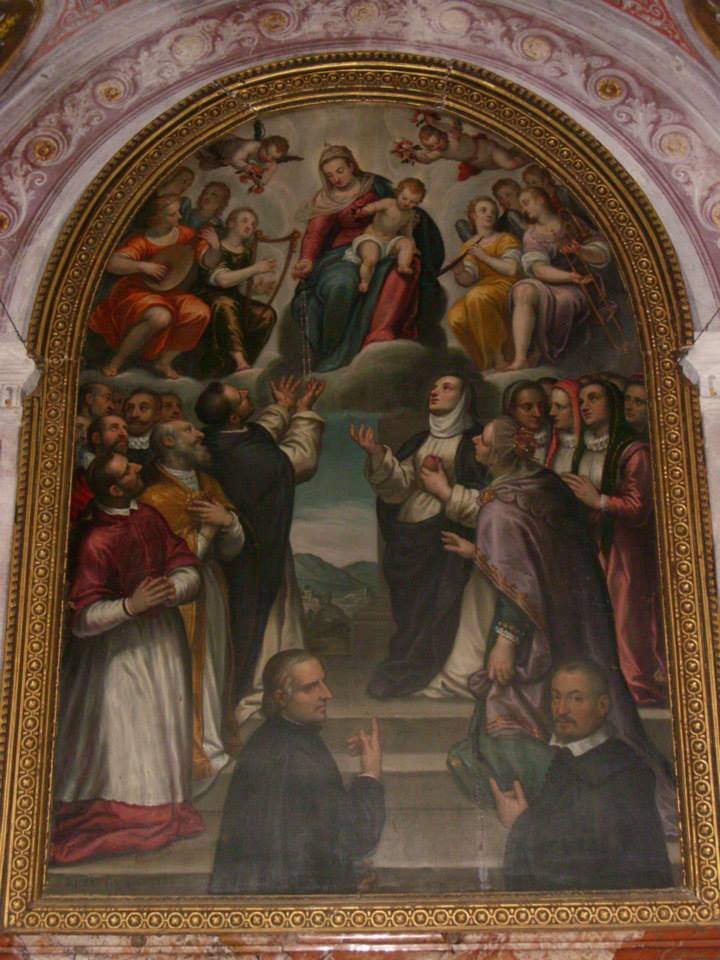
The Church of San Martino is enriched by extraordinary works of art created by members of the Pozzi family, originally from nearby Puria. Between 1590 and 1600, the four brothers Antonio, Francesco, Giovan Pietro, and Marco Antonio Pozzi, known as the "Belée," frescoed the presbytery, creating a striking pictorial cycle. Their works depict the Twelve Apostles, hosts of angels, scenes from the life of Saint Martin, episodes from the Passion of Christ, and an imposing representation of Christ in Glory.
One of the most evocative elements is the vault of the presbytery, decorated with false architecture that gives the illusion of a perspective breakthrough, visually expanding the space.
Francesco Pagani — The vault of the sacristy (1669)
In 1669, Francesco Pagani di Castello frescoed the vault of the sacristy with Stories from the Old Testament. This chronologically links the decoration by the Pozzi brothers (1590-1600) to Paolo Pagani's late-century cycle, demonstrating a continuity of local artists working in their parish church.
The Vault by Paolo Pagani
The Church of San Martino is famous for its majestic frescoed vault by Paolo Pagani (1655-1716), an artist originally from Castello. Between 1696 and 1697, at his own expense and out of personal devotion, he created the fresco on the church's vault, which today earns it the nickname "Lombardy's Sistine Chapel.".
The work depicts the Assumption of Mary in the center, surrounded by a complex interweaving of figures representing the journey of Jews and pagans. On the sides are scenes such as the Preaching of St. John the Baptist, the representation of Saints and Telamons, and the Judgment of the Three Saints.
A distinctive element of Pagani's work is the fact that the figures were painted directly onto the plaster, without the use of preparatory drawings, giving the work a unique and visually striking effect. The figures painted by Pagani are inspired by the great Michelangelo Buonarroti, an explicit reference that justifies the nickname “Sistine Chapel of Lombardy” by which the church is known today: not a rhetorical definition, but a direct iconographic homage to the greatest master of the Italian sixteenth century.
The iconographic key of the vault
The pictorial program of the vault frescoed by Paolo Pagani in the two-year period 1696-1697 operates on two parallel levels. On the religious level, it connects to the altarpieces below: humanity's journey of salvation from paganism to conversion, with the Preaching of St. John the Baptist, Saints Apollonia, Catherine of Alexandria, and Lucy, the Assumption of the Virgin, sibyls, and prophets. On the private level, it is the manifesto of the noble Pagani family: during the renovation of the birthplace, Paolo Pagani had declared that he had found documents attesting to the family's descent from three pagan kings of Africa who converted to Christianity — an operation aimed at legitimizing the nobility of his son Angelo Antonio through the inheritance of the Marquis Cesare Pagani of Milan.
Other Significant Works
On the counterfaçade, the large fresco depicting the Triumph of the Eucharist is the work of Gian Battista Pozzi, who took as his model a famous tapestry by Rubens preserved in Turin at the Savoy court. The theme was highly topical in the post-Tridentine era, when the Protestant Reformation had abolished the sacrament.
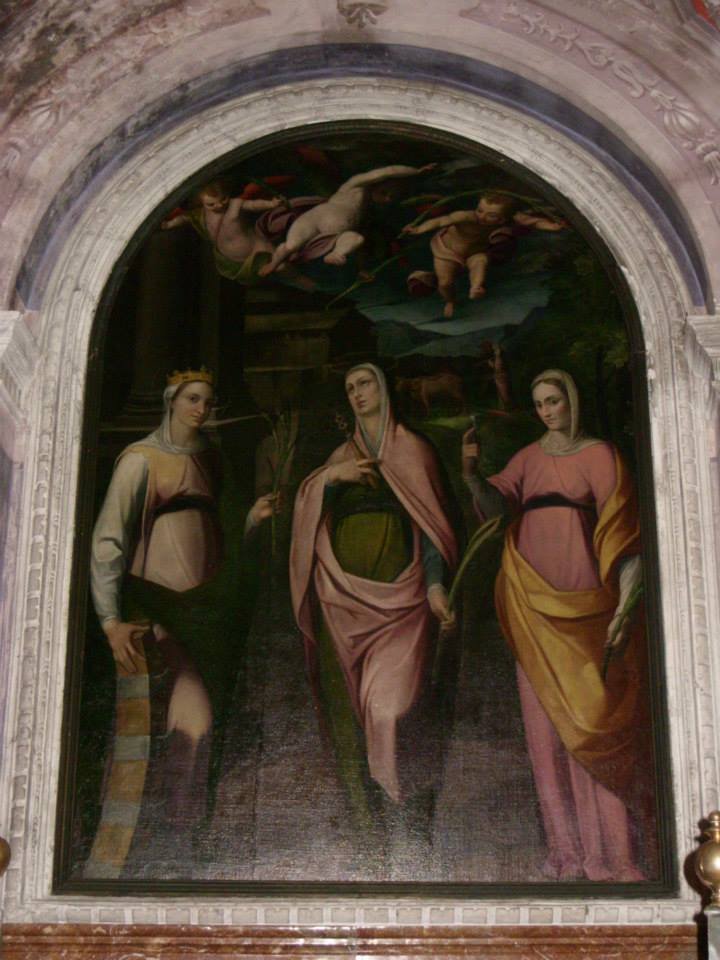
The church houses works by other Valsolda artists. Pietro Pozzi painted the canvas of the Beheading of Saint John the Baptist and the one depicting Saints Catherine of Alexandria, Apollonia, and Lucy around 1630. Giovanni Domenico Pozzi frescoed the baptistery in 1639 with the Baptism of Christ and a starry sky. In the last chapel on the right, a canvas by the Venetian artist Giovan Battista Maganza, created around 1615, further enriches the church's artistic heritage.
Castle, the Confalonieri and Pietro da Verona
Among the figures depicted, Saint Peter of Verona, depicted at the moment of his martyrdom, has a specific local historical significance. The inquisitor was killed on April 6, 1252, in the Barlassina forest on the Como-Milan road. Among those who ordered the murder was Stefano Confalonieri of Agliate, lord of Castello Castle and protector of the Cathars, a former Cathar of the church of Concorezzo. Confalonieri confessed his role in 1257 before the inquisitor Raniero Sacconi; the final sentence against him came only in 1295, 43 years after the events. The martyrdom of Peter of Verona is depicted in many churches in Valsolda.
Curiosity
In the chapel known as "dell'Impronta" (of the Footprint), a white marble plaque with the imprint of a left foot, traditionally attributed to Christ, is preserved. According to popular tradition, it was brought to Valsolda by Roman soldiers.
How to reach the church
Arriving from the hamlet of Oria, the church is located at the entrance to the medieval village of Castello di Valsolda, easily accessible on foot through the characteristic stone alleys. Those arriving by car can park near the town center and continue on foot for a few minutes.
Guided Tours
Discover the history, art, and secrets of the Church of San Martino with a certified tour guide. A unique experience to immerse yourself in the beauty of this Baroque masterpiece!
Gallery