Description
Discovering secret places
Claino is the historic hamlet of Claino con Osteno, where the atmosphere of an ancient village can still be felt. It is also home to the artistic project “Borgo Dipinto,” a widespread museum of art, history, and architecture overlooking the lake.
An open-air museum of art, history and architecture
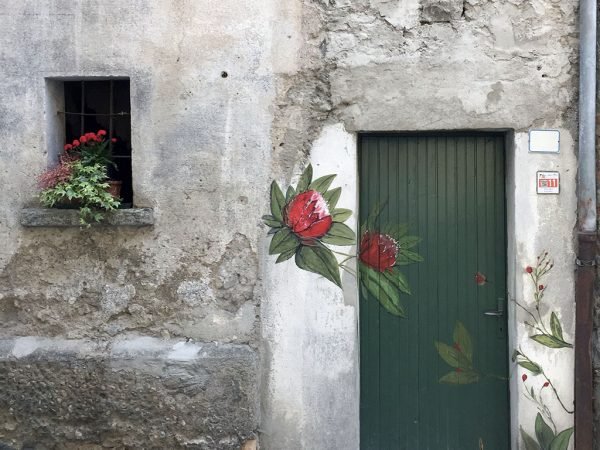
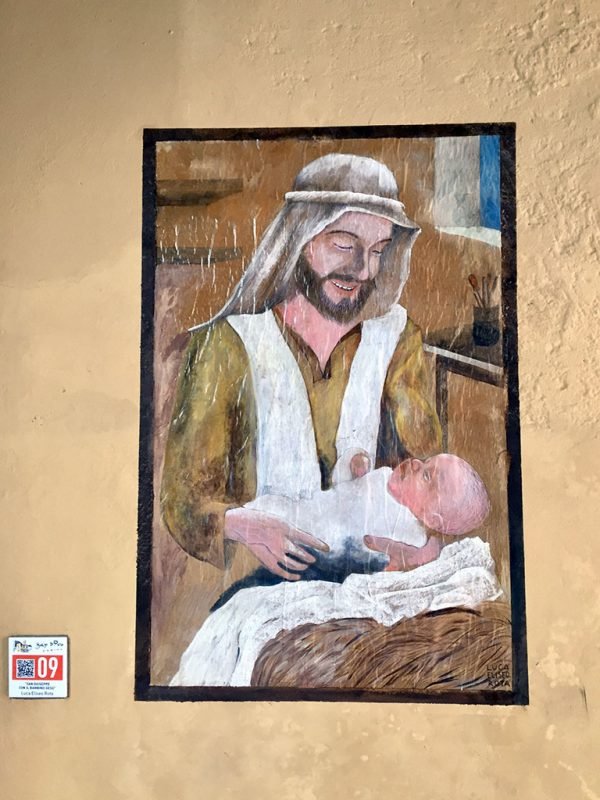
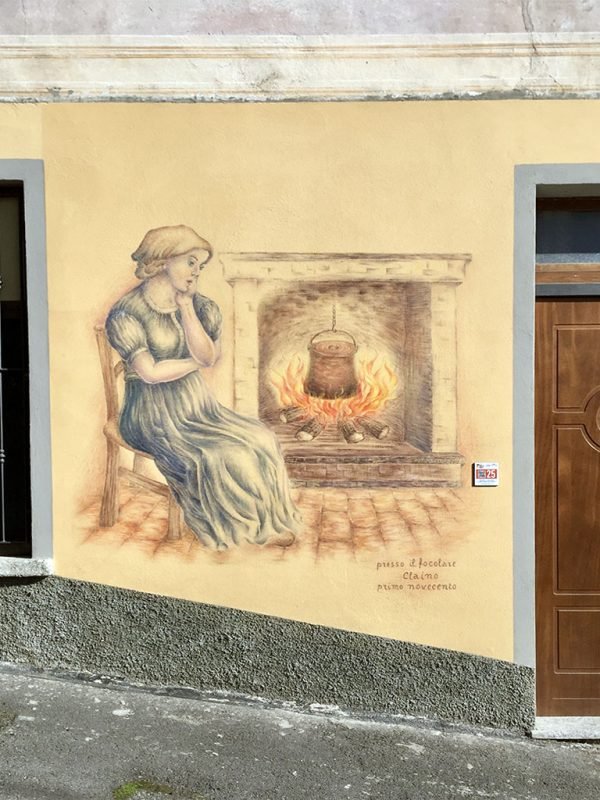
Nestled between the mountains of the Ceresio Valleys is Claino con Osteno, a true jewel of naturalistic and cultural interest in the province of Como which has seen the birth, in one of the main hamlets of the Municipality, of the project "Borgo Dipinto Claino", an initiative to revalue the medieval village which through artistic paintings of cultural and historical inspiration, has made it an open-air museum of art, history and architecture with a privileged view of the Lake Lugano and its Como mountains.
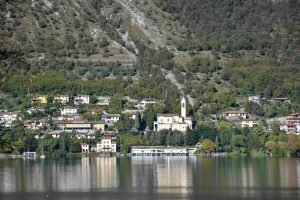
Situated on the southeastern shore of the lake, Claino presents unaltered the charm of a medieval village with evidence of considerable architectural interest.Surrounded by extensive forests, it stands on the remains of a medieval castle, an ancient strategic control point.
The idea was born in September 2015 from a letter from Claudia Pasquini and Luisella Parisi to the Municipality, who proposed enriching the village with artistic paintings inspired by local history, recalling how artists like the Magistri Comacini have left their mark on the area. The initiative was enthusiastically welcomed by Mayor Giovanni Bernasconi and his administration, who officially launched the project. The works created to date represent only the starting point of a future rich in new artists, drawings, and colors, which will enrich Claino's unique art gallery.
In Claino con Osteno art, culture and history come together
Artists such as the Magistri Comacini have left their mark here, and the ancient facades of the village's narrow streets lend themselves perfectly to paintings by contemporary artists on the houses of Claino... An open-air gallery with an artistic heritage, both ancient and recent, open to visitors free of charge every day of the year, a significant tourist attraction that adds to the area's already existing beauty.
The works and artists
Among the many works that enrich the village, numbers indicate the location on the official route map:
- n. 07b — Our Lady of Help — Catia Caracciolo Borra
- n. 07c — Madonna and Child — Gianpiero Trivelli
- n. 09b — Goats in the mountains — Daniela Antoniali — Pastoral mountain scene.
- No. 11b — In the fantastic world of giant pumpkins — Franco Mora
- n. 11c — Rose and Wisteria Decorations — Flarinia Peduzzi — Floral decorations on the facades of the village.
- n. 15b — I öch — Mariateresa Brambilla and Vilma Zinetti — A four-handed work, in local dialect.
- n. 20b — Celesta the seamstress — Anna Rodanò — Homage to the ancient craft of dressmaking.
- n. 21b — Waterfall — Philip Gugliotta —Depiction of the local waterfall.
- n. 26b — Homage to Leonardo and the moon — Luisella Parisi — A work by the project's co-founder, a tribute to the genius of Leonardo.
- n. 34b — Sum chi che va speci — Maria Antonia Scalise — Painting in local dialect that tells the story of life in the village.
- n. 37b — The Dream — Carmen Battaglia
- Oliver — Anna Rodanò
- Naive Landscape — Dino Dell'Oro
- The Carder — Sante Peduzzi (Güs) — Representation of the ancient craft of carding.
- Na feta de pulenta — Mariateresa Brambilla — Scene of daily life in local dialect.
- Pheasant on golden stone — Zanovello Francis — Naturalistic representation on gilded stone.
- The rejection of Santa Giulia — Alex Galli — Work inspired by the legend of Saint Julia.
- The Cobbler — Maria Antonia Scalise — Homage to the ancient craft of cobbler.
- Lest we forget our origins — Joseph Donghi — Work dedicated to local memory and traditions.
- Curious cat — Damaride Marangelli
These represent just a selection of the more than 40 works present in the village. The complete map with the orange numbers indicates the sequential order of all the works in Borgo Dipinto.
Points of interest in the village
In addition to the paintings, the route through the village touches on numerous points of historical and architectural interest, indicated on the map with special icons:
- St. Vincent Martyr Parish Church — 13th-century church with richly frescoed interiors, the spiritual heart of the village.
- Oratory of St. Joseph — Small oratory located in the shade of a portico in the heart of the village.
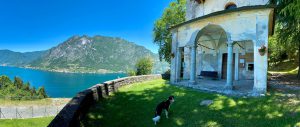
- Oratory of Santa Giulia — Reachable via a scenic walk of about 35 minutes along an ancient mule track. It dates back to the 17th century and offers breathtaking views of the lake.
- Medieval Porch — An evocative Romanesque portico, a testimony to the village's medieval architecture.
- Medieval Arch —Ancient stone arch marking one of the historic entrances to the medieval core.
- Scalotta — Characteristic stone staircase that connects the different levels of the perched village.
- Renaissance graffiti — Rare 16th-century monochrome mural decorations on some facades, a precious testimony to the Renaissance.
- Little Chapel — Small votive chapel along the route.
- Way of the Cross — Devotional path with sculptures (reachable in 15 minutes).
- Waterfall — A charming natural waterfall near the historic center.
- Fountain — Historic stone fountain from 1875, a traditional meeting point in the village.
- Viewpoint — Spectacular view of Lake Lugano and the surrounding Como mountains.
- War Memorial — Memorial dedicated to the fallen of the world wars.
- Pegé wash house —Ancient public washhouse still used by residents today.
- Cemetery — Historic village cemetery with contemporary murals.
There is a’app with QR code to track and get detailed information about each work.

Nearby
- Caves of Rescia — In the homonymous hamlet of Rescia di Claino con Osteno, the only fully tourist-friendly caves in Lombardy, rich in stalactites and stalagmites already visited in the 18th century.
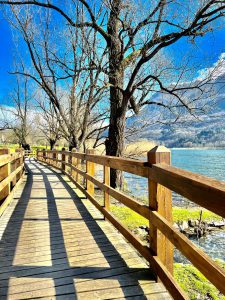
- Osteno Lido — In the historic hamlet of Osteno, a natural beach has developed over the years with magnificent centuries-old trees, from which you can admire the passing of swans, mallards, gray herons, and cormorants.
- Oratory of Santa Giulia — From Claino, a scenic walk of about 35 minutes along an ancient mule track takes you to the promontory on which stands the small and beloved Oratory of Santa Giulia, which, as evidenced by the bell tower, dates back to the 17th century.
Experiences
- Artistic walk — Discover the over 40 paintings scattered throughout the streets of the Borgo di Claino.
Gallery