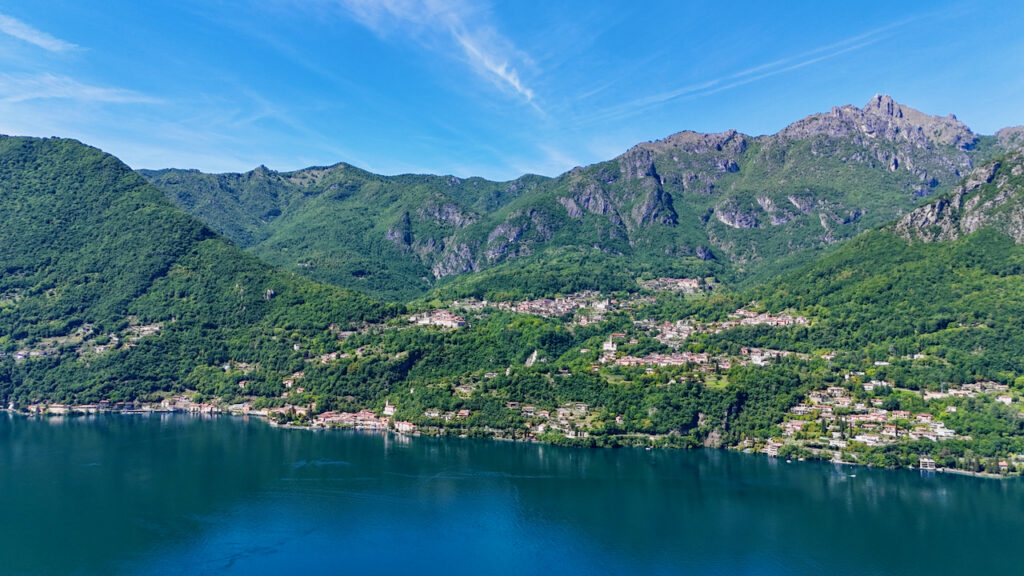
La Valsolda It is a scattered municipality in the province of Como, in Lombardy, overlooking the northern branch of the Lake Ceresio on the border with Switzerland between Lugano and Porlezza. Its territory coincides with that of the valley, crossed by the Soldo stream and enclosed by a semicircular mountain range. common, formed in 1927 from the merger of six pre-existing municipalities, is today divided into eleven hamlets distributed between the shores of the lake (Cressogno, San Mamete, Albogasio Inferiore and Superiore, Oria, Santa Margherita) and the slopes of the mountain (Loggio, Drano, Puria, Dasio, Castello). The municipal seat is in San Mamete, where the church of Saints Mamete and Agapito preserves an 11th-century Romanesque bell tower. Historically, Valsolda was for centuries a fiefdom of the archiepiscopal table of Milan: San Carlo Borromeo himself signed Dominus Vallissoldae, "Lord of Valsolda".
The international fame of the valley is due to Antonio Fogazzaro, who set in Oria Small ancient world (1895): his house, today Villa Fogazzaro Roi managed by the FAI, it can still be visited in its original 19th-century atmosphere. The hamlet of Castello, perched on a rocky spur, preserves the Church of San Martino, known as the "Sistine Chapel of Lombardy" for the 1697 frescoes painted by the Valsolda painter Paolo Pagani (1655-1716) directly on the plaster, without a preparatory drawing. Between the 16th and 18th centuries, Valsolda gave birth to numerous architects, painters, sculptors and plasterers who exported their art from Italy to Spain, from Central Europe to Poland, Lithuania, Russia and Sweden: a history today documented by the Pagani House Museum, housed in the artist's original home in Castello and considered the most important museum in Europe dedicated to his works.
The hamlets of Valsolda—villages between the lake and the mountains
The eleven fractions of Valsolda are distributed along two distinct altimetric bands. Saint Mamete, the municipal seat at the mouth of the Soldo stream, is the historic port of the valley, with its 11th-century Romanesque bell tower and 17th-century lazaretto. Cressogno e Lower and Upper Albogasio dot the lake shore with period villas and private docks. Oria, facing the promontory of San Mamete, preserves the home of Antonio Fogazzaro, now a FAI property. On the slopes of the mountain, Castle it stands on a rocky spur at 720 metres, guarding the church of San Martino with its seventeenth-century frescoes; Lodge, Puria, Drano e Dasio They are rural agricultural hamlets nestled among terraced vineyards and olive groves, accessible via ancient paved mule tracks. Each hamlet preserves fountains, wash houses, and votive chapels that bear witness to the daily life of an Alpine-lake community.
Many of these ancient mule tracks are still passable on foot: the walks in Valsolda they connect the hamlets of the lake to the paths of the Regional Forest that climbs towards the mountain.
Santa Margherita — the village that can only be reached by lake
Saint Margaret It is a unique hamlet in the Ceresio panorama: a very small inhabited nucleus nestled on a narrow inlet on the Valsoldese shore, reachable only by lake by boat or via a steep panoramic path starting from Albogasio Superiore. The village preserves a 12th-century Romanesque church with a rare fresco dated 1427 depicting Saint Margaret of Antioch, and the remains of a lazaretto where during the Manzonian plague of 1630 the infected people of Valsolda were confined. In the 1940s and 1950s Santa Margherita was also the starting point for a panoramic funicular which connected the lake basin with the plateau of Lanzo d'Intelvi: the structure, dismantled in 1977, is remembered today only by a few period photographs and a short stretch of track that remains as a memorial.
Literature — Valsolda, land of writers
Few Italian territories boast a literary density equal to that of Valsolda. Antonio Fogazzaro he set his masterpiece here Small ancient world (1895), making the hamlet of Oria the emotional and narrative setting of the novel. The Swiss-German writer Hermann Hesse, Nobel Prize for Literature in 1946, painted a watercolor of Lower Albogasio during one of his stays on Lake Ceresio, now preserved in a private collection. Brunella Gasperini, pseudonym of Bianca Robecchi, one of the most popular Italian journalists and writers of the second half of the twentieth century, chose San Mamete as her summer residence for over thirty years. More recently, since 2015, the writer Emiliano Bezzon He set some of his noir novels in Valsolda, helping to keep alive the tradition that makes the valley an exceptional literary setting.
Artistic emigration from Valsoldo—architects, painters, sculptors, and plasterers throughout Europe
Between the The sixteenth and eighteenth centuries, Valsolda gave birth to generations of artists who exported their art throughout Europe. The families involved were numerous: the Get along of Albogasio, the Bellotti, i Fountain, i Merlins, i Ceroni, i Puttini, i Well of Puria, the Little faces of Castello, the Lezzeni of Albogasio. To these is added the monumental figure of Pilgrim Tibaldi of Puria (1527-1596), one of the major protagonists of post-Michelangelo Mannerism, active between Bologna, Milan and the court of Philip II of Spain.
Among the figures documented at Pagani House Museum stand out Isidoro Affaitati (Albogasio, ca. 1622-1684), first architect of the King of Poland and author of churches and palaces in the Republic of the Two Nations (Kingdom of Poland and Grand Duchy of Lithuania); his brother Carlo Ambrogio Affaitati, Canon of Warmia and confessor of Queen Maria Luigia Gonzaga; Carlo Ceroni, architect active in Węgrów (Poland) at the beginning of the eighteenth century, where even today a street bears his name; and Domenico Merlini, first architect of the king of Poland Stanislaus August Poniatowski. Paul Pagani (1655-1716) di Castello was a court painter between Venice, Vienna and the Habsburg lands of central Europe, working for Emperor Leopold I in Vienna, for Prince-Bishop Karel Liechtenstein Castelcorn in Moravia (Kroměříž) and in Krakow in Poland. A history today documented by the Pagani House Museum, the only exhibition space in Europe dedicated to artistic emigration from Valsoldo.
Points of interest in Valsolda
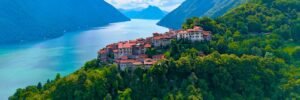
Borgo di Castello in Valsolda
Castle in Valsolda: a medieval village perched on Lake Ceresio, the birthplace of Paolo Pagani and a workshop for emigrant architects…
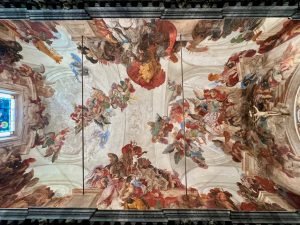
Church of San Martino in Castello Valsolda
Known as the "Sistine Chapel of Lombardy," it houses extraordinary frescoes by Paolo Pagani in the medieval village of Castello…
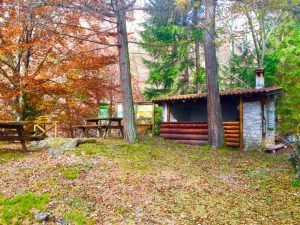
Valsolda Regional Forest
The Valsolda Regional Forest is Lombardy's first nature reserve, with 318 hectares of pristine nature between…
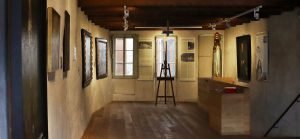
Pagani House Museum
Pagani House Museum in Castello Valsolda: the most important museum in Europe dedicated to the painter Paolo Pagani…
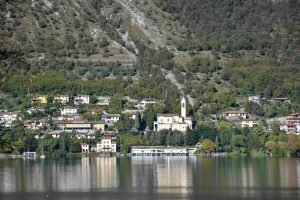
Sanctuary of the Blessed Virgin of Caravina
The Marian sanctuary of Valsolda, between miracles, Baroque art, and the devotion of Charles Borromeo. The Sanctuary of…
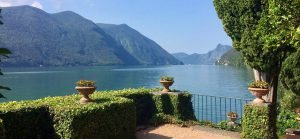
Villa Fogazzaro Roi
In Oria, a small village on the Como shores of Lake Ceresio, time seems to have stood still, the places impermeable…
Restaurants in Valsolda
Crotto Campo
A traditional trattoria nestled in the green woods of Valsolda. Wood-fired pizza and homemade desserts…
King Pub
The Warmth of the Sun at a Bar Counter. A pub in the heart of San Mamete Valsolda, with a welcoming atmosphere...
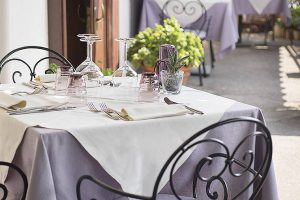
La Lanterna Inn
A restaurant serving revisited traditional cuisine led by Chef Pamela Paredi, located in the heart of Valsolda on Lake Ceresio. Ingredients…
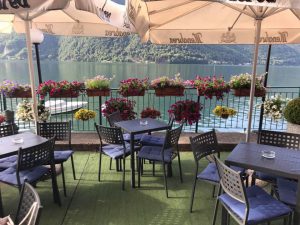
Simona Snack Bar
Snack bar with a panoramic terrace overlooking Lake Ceresio in Albogasio Valsolda. Coffee, aperitifs, platters, and gourmet piadinas. Near…
Routes in Valsolda
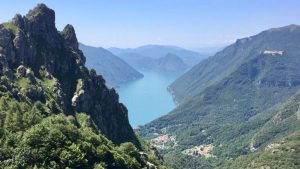
Valsolda Regional Forest
A circular hike in the Valsolda Regional Forest from Dasio. A trail through flora, fauna, waterfalls, autumn foliage, and panoramic views...
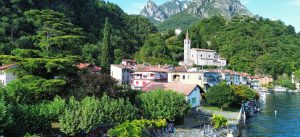
Valsolda, Tour of the Hamlets
The route begins in the charming Piazza Roma in San Mamete, considered the heart of the municipality of Valsolda. After passing the church...