Description
The oldest church in the Deanery: a journey through art and faith from the 5th century
In brief
La Prepositural Church of St. Victor a Porlezza it is the oldest in the deanery, with origins dating back to 5th century AD. Overlooking the Lake Ceresio, holds within it an artistic heritage of great value, with frescoes by Giulio Quaglio from Laino, John Baptist Well and other Lombard Baroque masters. The neoclassical facade, designed by Pietro Gilardoni da Puria, introduces to an interior rich in side chapels, marble altars, and intelvese handcrafted scagliola decorations.
History and Architecture
The origins of the church date back to the 5th century, when it was already a plebeian church with a presbytery, baptistery, and a walled sacred area. In the 6th century, it was led by an archpriest appointed by the people and the clergy, with administrative and community governance duties. During the 8th century, the presbyter and clerics lived in community near the plebeian church, a tradition maintained at least until the 13th century.
In 12th century It underwent a complete reconstruction that erased the early Christian traces. In 1428 James Maggi he commissioned a “Madonna and Child”, still visible between the second and third chapels on the right.
After the Borromean visits and the Council of Trent, parish priest Pocobelli (elected in 1634) promoted major extension works. Between 1650 and 1670 the new chapel was erected with contributions from the families Bonanomi e Adrians. Work was completed in 1678 with the construction of three chapels on each side.
Chapels and Frescoes
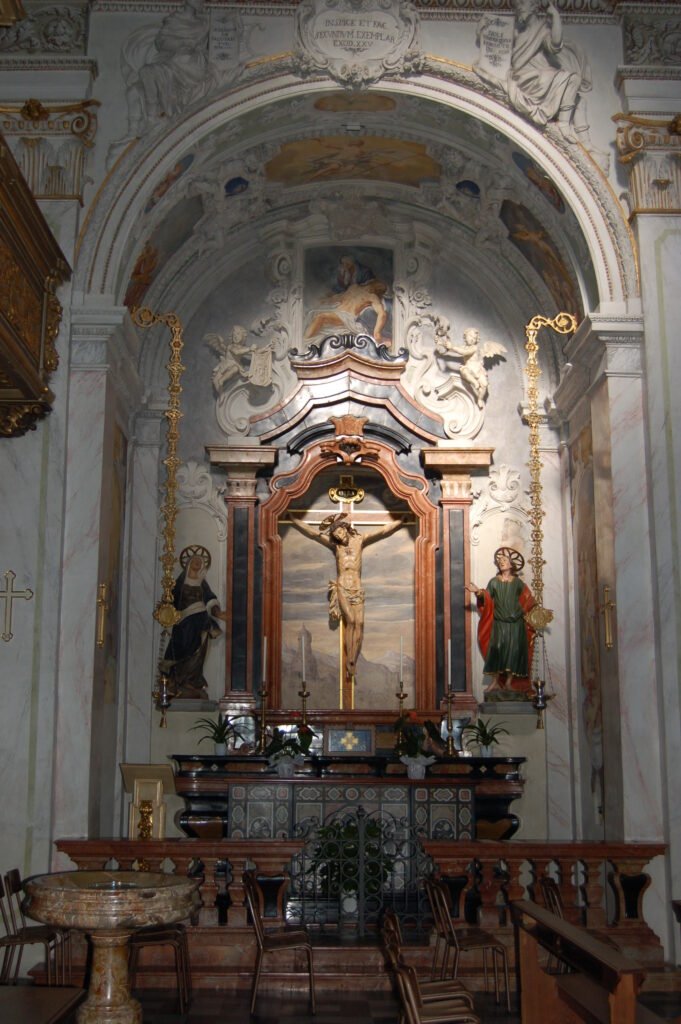
La first chapel left (of the Crucifix) was frescoed in the 18th century by Giulio Quaglio from Laino with the “Stories of the Passion of Christ”. Quaglio himself decorated the Chapel of St. Maurice, dedicated to the patron saint of a church buried under a landslide on Mount Galbiga.
La second chapel left houses a marble altar dedicated to Our Lady of the Rosary, commissioned by the Bolza family of Loveno. The third chapel on the left (of St. Charles) was frescoed by John Baptist Well with stories of the saint, while a canvas is the work of Pietro Pozzo Vignola.
The 15th-16th century tabernacle features the 'Ecce Homo” with a scagliola antependium of Intelvi craftsmanship, perhaps the work of the Solari of Verna.
The High Altar and the Choir
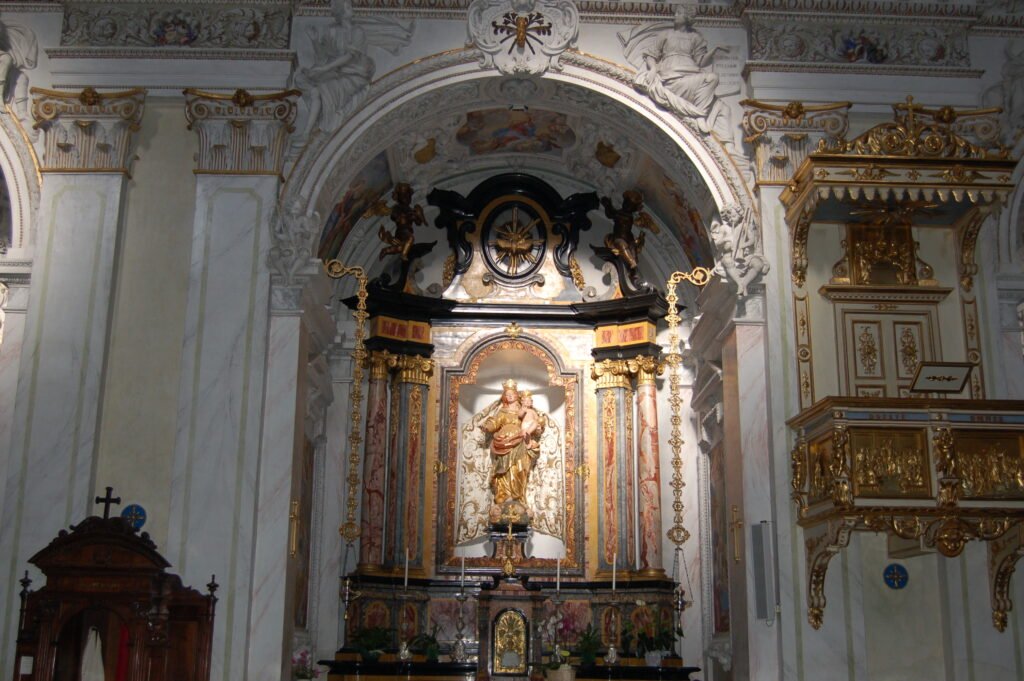
In 1736 the sculptor James Mary Muttone he created the stucco statues of Saints Ambrose and Charles.’high altar wooden tempietto with twisted columns was executed in 1684 by Giuseppe Gaffuri Como.
In 1692 Giovanni Battista Pozzo da Loggio He frescoed the choir with the "Glory of Saint Victor", the "Fustigation of Saint Victor" and "Saint Victor Imprisoned". His sons Giovanni Battista junior and Carlo Antonino completed the work, decorating the vault of the presbytery with the "Coronation of the Virgin" and the prophets.
The Oratory of St. John the Baptist
In 1682 the’Oratory of St. John the Baptist reusing the old apse of the plebian church and preserving precious frescoes from the 14th century.
The Neoclassical Façade
At the beginning of the nineteenth century, Pietro Gilardoni da Puria He designed the neoclassical façade with four semi-columns and ashlar, as well as remodeling the bell tower. Between 1866 and 1876 John Valtorta he painted the vault with “Glories” and six “Prophets” in the sails. James Medici in 1876 he decorated the arches of the baptistery in the Second Empire style.
Gallery